



Now Study
When someone is choking, they may be unable to breathe properly. Find out what to look for and what to do.
The patient may be:
- Gagging
- Coughing
- Wheezing
- Watery eyes
- Red face
- Not able to speak or use full volume
- Panicked or distress behaviour
When choking is severe the person won’t be able to speak, cry, cough or breath without help.
There are no breath sounds from the mouth or nose. When choking is severe the person will not be able to speak cry or breath. Without any help they will eventually become unconscious.
What is choking?
When someone is choking, their airway is partly or completely blocked, meaning they may be unable to breathe properly. They might be able to clear it by coughing, but if they can’t you will need to help them straight away.
If you think someone is choking, ask them: “Are you choking?”. If they can breathe, speak or cough then they might be able to clear their own throat. If they cannot breathe, cough, or make any noise, then they need your help straight away.
Either:
- Cough it out. Encourage them to cough and remove any obvious obstruction from their mouth.
- Hit it out. If coughing fails to work, you need to give five sharp back blows.
Back blows
To perform back blows, help the person to lean forwards, supporting their upper body with one hand.
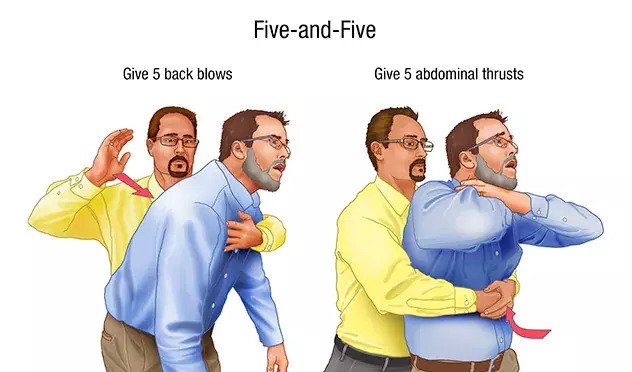
With the heel of your other hand give them five sharp back blows between their shoulder blades.
After each back blow, check to see if there’s anything in their mouth.
Squeeze it out. If back blows fail to clear the obstruction, give five abdominal thrusts.
To do this, stand behind them and put your arms around their waist.
Place one hand in a clenched fist between their belly button and the bottom of their chest.
With your other hand, grasp your fist and pull sharply inwards and upwards up to five times. Check their mouth again, each time.
If the blockage has not cleared, call 999 or 111 for emergency help straight away. Repeat five back blows and five abdominal thrusts until help arrives, re-checking their mouth each time.
If they become unresponsive at any point, prepare to start adult CPR.
- If you’re working as a self employed beautician and you’re not in a salon environment (and there is no health and safety executive present), you must undertake an additional first aid & CPR course. These are available to do online from £25 (basic first aid is included in this course).
Mild choking: encourage them to cough
If the airway is only partly blocked, the person will usually be able to speak, cry, cough or breathe.
They’ll usually be able to clear the blockage themselves.
To help with mild choking in an adult or child over 1 year old:
- Encourage them to keep coughing to try to clear the blockage
- Ask them to try to spit out the object if it’s in their mouth
- Don’t put your fingers in their mouth to help them as they may bite you accidentally
If coughing doesn’t work, start back blows.
Severe choking: back blows
Where choking is severe, the person won’t be able to speak, cry, cough or breathe. Without help, they’ll eventually become unconscious.

To carry out a back blow on an adult or child over 1 year old (infants less that 1 years are not suitable for back blows):
- Stand behind them and slightly to one side. Support their chest with 1 hand. Lean them forward so the object blocking their airway will come out of their mouth, rather than moving further down.
- Give up to 5 sharp blows between their shoulder blades with the heel of your hand. The heel is between the palm of your hand and your wrist.
- Check if the blockage has cleared.
- If not, give up to 5 abdominal thrusts
Abdominal thrusts
Choking is when someone is having a very hard time breathing because food, a toy, or other object is blocking the throat or windpipe (airway).
A choking person’s airway may be blocked so that not enough oxygen reaches the lungs. Without oxygen, brain damage can occur in as little as 4 to 6 minutes. Rapid first aid for choking can save a person’s life.
Abdominal thrusts is an emergency technique to help clear someone’s airway.
- The procedure is done on someone who is choking and also conscious.
- Most experts do not recommend abdominal thrusts for infants less than 1 year old.
- You can also perform the manoeuvre yourself.
First ask, “Are you choking? Can you speak?”. DO NOT perform first aid if the person is coughing forcefully and is able to speak. A strong cough can often dislodge the object.
If the person is choking, perform abdominal thrusts as follows:
- If the person is sitting or standing, position yourself behind the person and reach your arms around his or her waist. For a child, you may have to kneel.
- Place your fist, thumb side in, just above the person’s navel (belly button).
- Grasp the fist tightly with your other hand.
- Make quick, upward and inward thrusts with your fist.
- If the person is lying on his or her back, straddle the person facing the head. Push your grasped fist upward and inward in a movement similar to the one above.
You may need to repeat the procedure several times before the object is dislodged. If repeated attempts do not free the airway, call 911 or the local emergency number.
If the person loses consciousness, start CPR.
If you are not comfortable performing abdominal thrusts, you can perform back blows instead on a person who is choking.